Who's Still Hiring in 2026? Industries That Are Adding Jobs Like Crazy (Despite What AI Headlines Tell You)
Scared AI is taking all the jobs? The data says otherwise. Here are six industries massively hiring in 2026 and the entry-level roles you can land right now.


If your social media feed is nothing but "AI will replace everyone" hot takes, take a breath. The actual data tells a very different story.
It's easy to feel like the sky is falling. Every other headline is about another round of layoffs, another AI tool that can do your job in half the time, another tech CEO talking about how humans are becoming obsolete. If you're early in your career or just starting your job search, all of that noise can feel paralyzing.
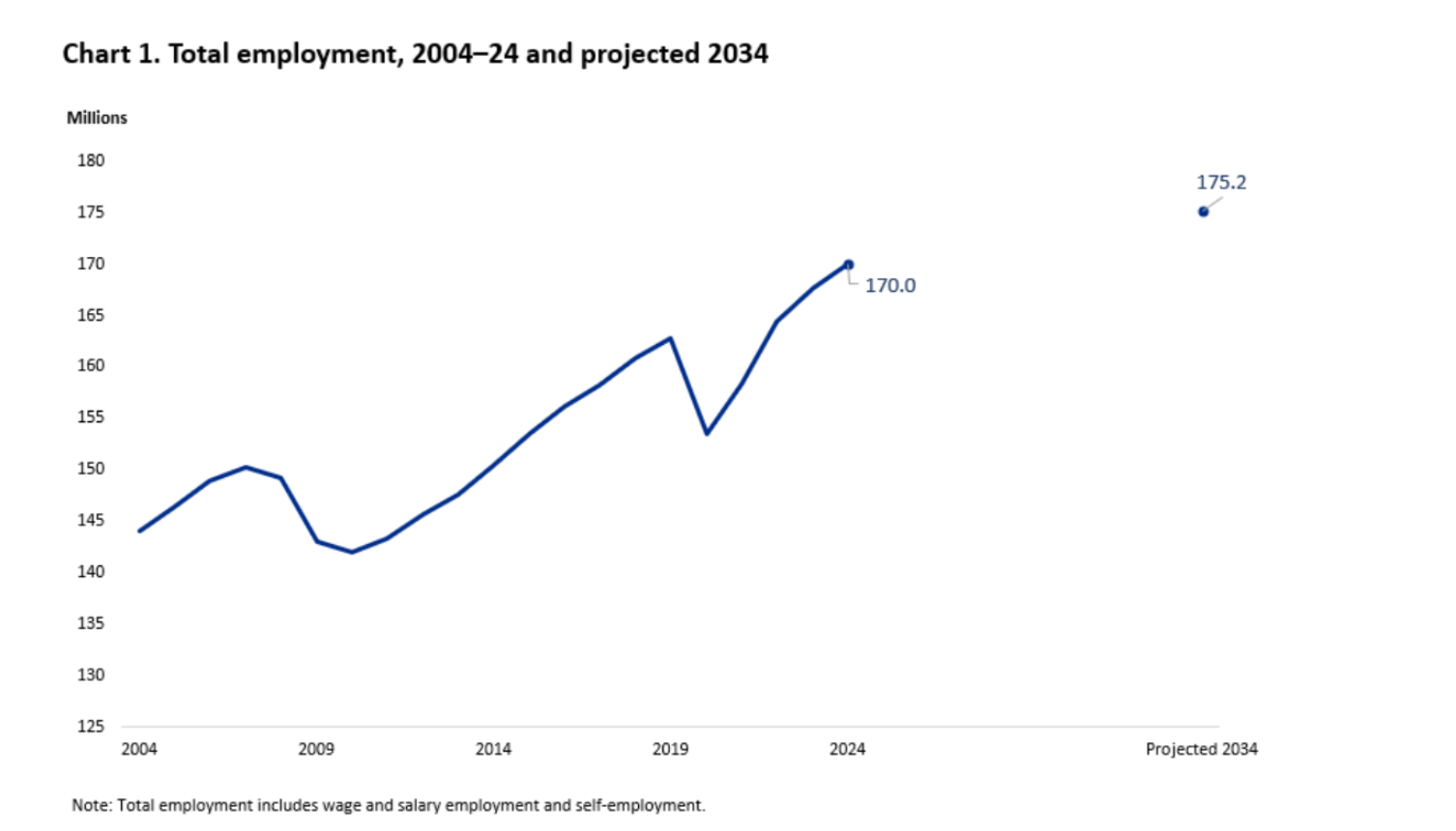
But here's what the panic merchants aren't telling you: the U.S. economy is projected to add 5.2 million new jobs between 2024 and 2034, according to the Bureau of Labor Statistics. The World Economic Forum projects a net gain of 78 million jobs globally by 2030, even after accounting for roles displaced by automation. Jobs are not disappearing. They're moving.
The question isn't whether there are jobs out there. It's where to look.
Healthcare: The Unstoppable Hiring Machine
If there's one sector you can bet on with your eyes closed, it's healthcare. The BLS projects healthcare and social assistance to grow 8.4% over the next decade, adding roughly 2 million new jobs. That makes it the single fastest-growing and largest job-producing sector in the entire economy.
And this isn't just about doctors and surgeons. The roles growing fastest are the ones you can get into without spending a decade in school. Home health aides, personal care aides, medical assistants, dental hygienists, physical therapy assistants. These are hands-on, people-facing jobs that AI simply cannot do. You can't send a robot to help someone recover from hip surgery or comfort a patient during a difficult diagnosis.
Indeed's 2026 Best Jobs report backs this up: seven of the top 10 jobs on their list are in healthcare. As their research director put it, healthcare represents the vast majority of actual job growth in the broader market right now, even though it's only about 11% of total jobs.
The aging population is the engine here. More Americans are living longer, and they need care. That demand isn't going away in your lifetime. If anything, it accelerates.
Entry-level paths worth exploring: Certified nursing assistant (CNA), medical billing and coding, phlebotomy technician, home health aide, healthcare administrative support.
Skilled Trades and Construction: More Jobs Than Workers
Here's an industry with a problem most sectors would love to have: not enough people to fill the positions.
Construction and infrastructure are booming, powered by a wave of federal spending on roads, bridges, energy projects, and domestic manufacturing facilities. The CHIPS Act alone is converting into massive multi-year projects. Samsung's semiconductor facility in Texas is expected to create thousands of jobs. TSMC, Micron, and others are building new plants across the country.
Electricians, HVAC technicians, plumbers, welders, and heavy equipment operators are in enormous demand, and these roles pay well. An electrician specializing in data center or solar installation can earn $80,000 to $100,000 or more with overtime. These are physically hands-on jobs that require real-world problem solving in unpredictable environments. AI is nowhere close to replacing someone who has to troubleshoot a faulty circuit breaker in a half-built warehouse at 6 AM.
The skilled trades workforce is also aging out. A massive wave of retirements is creating openings faster than apprenticeship programs can fill them. If you're willing to learn a trade, you're walking into one of the tightest labor markets in the country.
Entry-level paths worth exploring: Apprenticeships in electrical, plumbing, or HVAC; construction laborer positions that offer on-the-job training; solar panel installation.
Tech (Yes, Really, but It's Different Now)
Tech gets the scariest headlines, and some of them are earned. Big companies have pulled back. H-1B filings from Amazon, Google, Meta, and Microsoft all dropped significantly in early 2026. Generalist developer roles have thinned out.
But here's the nuance: tech employment overall is still growing. CompTIA projects net tech employment to grow by about 1.9% in 2026, roughly 128,000 additional jobs. The sector isn't shrinking. It's reshaping.
The roles that are expanding are the ones that work alongside AI, not the ones AI replaces. Cybersecurity analysts, data scientists, AI/ML engineers, cloud architects, and DevOps specialists are in serious demand. The BLS projects computer and mathematical occupations to grow 10.1% over the coming decade, more than three times the average for all jobs.
The shift is clear: companies want fewer people who do routine coding and more people who can build, secure, and manage complex systems. If you're entering tech right now, the move is to specialize early. Pick a lane: security, data, infrastructure, or AI tooling. Learn to use AI productively rather than competing with it. That's the difference between being replaced and being promoted.
Entry-level paths worth exploring: IT support/helpdesk (CompTIA A+ certification), junior cybersecurity analyst, data annotation specialist, QA testing, cloud support associate.
Clean Energy and EV Infrastructure
The four fastest-growing industries in the BLS projections are all in energy generation: solar, wind, geothermal, and related electric power. Battery manufacturing is right behind them. The clean energy transition isn't a talking point anymore. It's a hiring pipeline.
Solar photovoltaic installers and wind turbine service technicians are among the fastest-growing job titles in America. Electric vehicle infrastructure is creating demand for technicians who can install and maintain charging networks across the country. These roles don't require four-year degrees. Many of them train on the job or through short certification programs.
This sector is also getting a boost from the infrastructure spending wave. Federal incentives and state mandates are accelerating timelines, and companies are staffing up to meet them.
Entry-level paths worth exploring: Solar installation technician, EV charging station installer, wind turbine technician trainee, energy auditor.
Logistics, Warehousing, and Last-Mile Delivery
E-commerce isn't slowing down, and every package that gets ordered has to get to someone's door. The transportation and warehousing sector is projected to grow 3%, driven by an ever-increasing volume of parcel shipments and deliveries.
Amazon alone continues to hire at massive scale across fulfillment and delivery operations. But it's not just Amazon. Every major retailer with an online presence needs warehouse staff, delivery drivers, logistics coordinators, and supply chain support. Same-day and next-day delivery expectations have made last-mile logistics one of the most labor-intensive parts of the economy.
Yes, automation is entering warehouses. But it's augmenting human workers, not replacing them, at least not yet. Someone still needs to manage the robots, troubleshoot the conveyors, and handle the exceptions that automated systems can't figure out.
Entry-level paths worth exploring: Warehouse associate, delivery driver, logistics coordinator, inventory specialist, supply chain analyst.
Government and Public Sector
While the private sector gets all the attention, federal, state, and local governments remain among the largest employers in the country. And they're facing the same retirement wave as the trades. Entire departments are cycling through leadership and frontline staff over the next several years.
Administrative assistants, caseworkers, public health coordinators, IT support, and law enforcement are all hiring. Government jobs often come with benefits packages that are hard to match in the private sector: health insurance, pension plans, job stability, and structured advancement.
For entry-level candidates, government roles can be a smart play. The hiring process is slower and more bureaucratic, but the trade-off is a level of security that most private sector jobs can't offer.
Entry-level paths worth exploring: Administrative assistant (federal/state/local), 911 dispatcher, park ranger, DMV or social services caseworker, public health assistant.
The Main Takeaway
AI is changing what some jobs look like. That's real. But the narrative that jobs are vanishing overnight is not supported by the data. What's actually happening is a redistribution. Routine, repetitive tasks are getting automated. Roles that require physical presence, human judgment, empathy, and complex problem solving are growing.
The best move you can make right now isn't to panic. It's to aim your search at the sectors that are expanding, build the skills those sectors value, and position yourself as someone who works with new technology rather than hiding from it.
The jobs are out there. You just have to know where to look.
Ready to start your search? Browse thousands of entry-level opportunities on DayOneJobs and find the one that's right for you.